AICA
AI Intercultural Communication Assistant: a privacy-first Expo app that advises on cross-cultural messages, not just translates them.
askaica.app- Role
- Founder / Full-Stack Mobile Engineer
- Timeline
- 2025–2026 · Foundation Dec 2025, MVP build Jan–Mar 2026
- Team
- Solo builder: product, schema, advisor architecture, UI, auth, and subscription surface
- Stack
- Expo 54, React Native 0.81, React 19
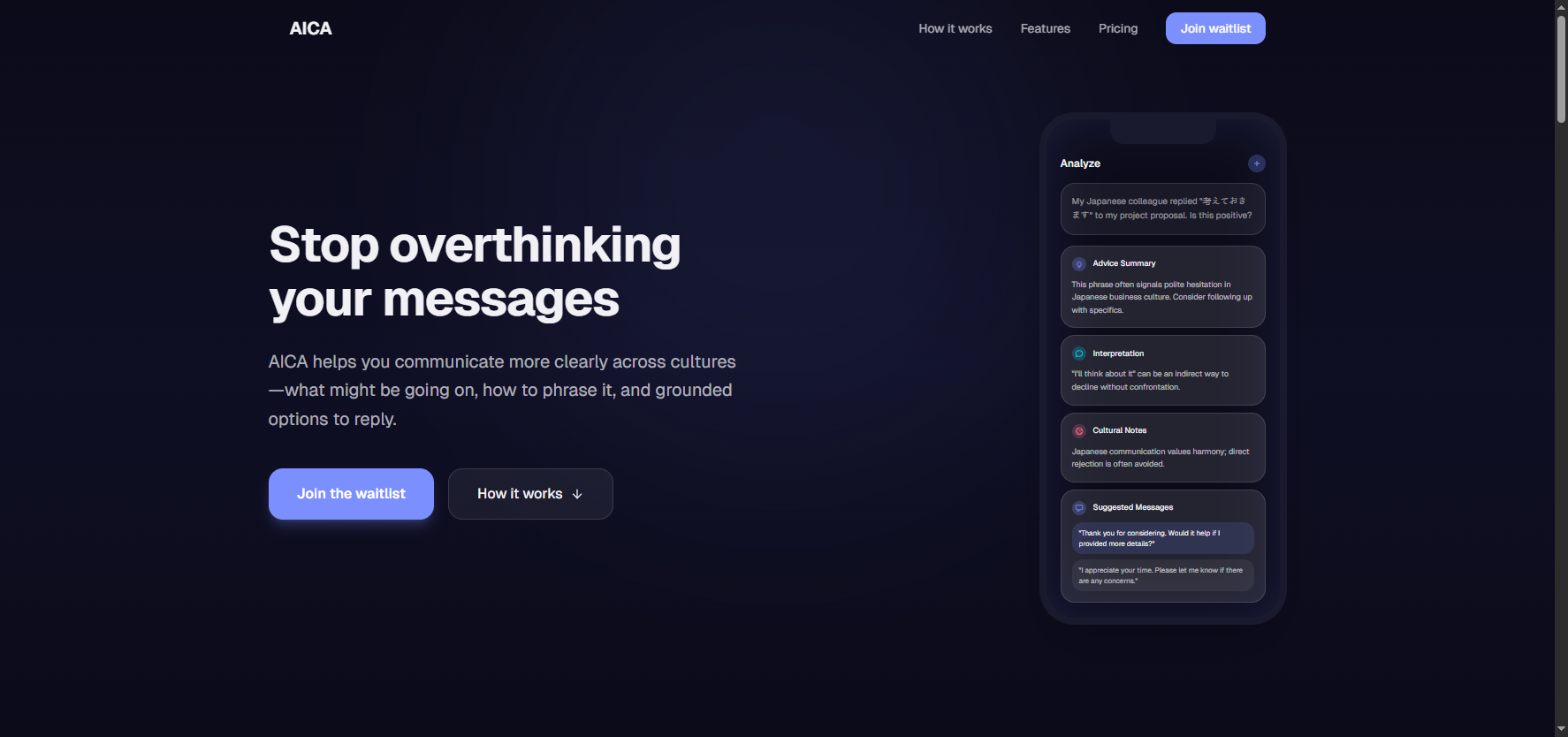
AICA helps people navigate cross-cultural communication on their phone: paste a conversation or describe a situation, pick a persona (work, dating, academic, travel, casual), and get interpretation, cultural notes, and suggested replies. I designed and built the product end to end as an Expo Router app (glass UI, auth/onboarding, Analyze → Result → History, personas CRUD, tips, and freemium gating) with a local-first AI path (expo-ai-kit) that falls back to an OpenRouter model via a Supabase Edge Function when confidence is low and the user still has quota.
The problem
Translation tools fix wording, not culture. Someone can write grammatically perfect Japanese and still miss formality, indirect refusal, or workplace norms, and existing apps rarely warn about that. Cross-cultural friction shows up daily for remote teams, international couples, students abroad, and expats sharing sensitive conversations.
AICA needed to feel like a cultural advisor in your pocket: actionable advice tailored to context (persona + language pair), with privacy as table stakes, not a chatbot that ships every message to the cloud by default.
My approach
I built AICA as an Expo ~54 / React Native app with file-based Expo Router: auth stack (welcome, Google OAuth + email/password, language), then tabs for Analyze, History, Personas, and Settings. Domain state lives in React Context (Auth, Message, Persona); history is AES-encrypted locally; personas are local-first with optional Supabase sync when privacy settings allow.
The differentiator is the advisor stack: try on-device inference first via expo-ai-kit; if confidence is below threshold and the user has remaining weekly quota, call a Supabase Edge Function that proxies OpenRouter (Gemini 2.5 Flash). Free limits (5 online requests/week, 2 personas, 1000 chars) and Pro CTAs create upgrade moments without requiring Stripe yet. Waitlist and subscription UI are in place for the next monetization step.
Product & engineering details
Shipped surface includes the Analyze textarea with persona pills and usage dots, Result cards (summary, interpretation, suggested copy-to-clipboard messages, cultural notes, feedback), encrypted History with persona filters, Personas CRUD across domain categories, random cultural tips with voting, privacy local-only mode, and Settings (account, Pro waitlist/pricing, debug).
Backend is Supabase: Auth, Postgres schema (profiles, personas, requests/responses, tips, feedback, waitlist, billing placeholders), RLS so users only touch their own rows, and the advisor Edge Function. Tests cover advisor decision/local model paths and key services with Jest + React Native Testing Library. Honest scope gaps: Draft rewriting API, traffic-light signals, Stripe checkout, and store submissions remain post-MVP.
Outcome
AICA is a working end-to-end MVP: signup → analyze → culturally aware advice → save to history, with on-device-first AI and a real online fallback. The codebase is a coherent Expo product foundation (glass design system, typed routes, Supabase-backed auth and quota, and a clear freemium path), ready for Stripe, Draft AI, TestFlight / Play internal testing, and a public askaica.app launch.